

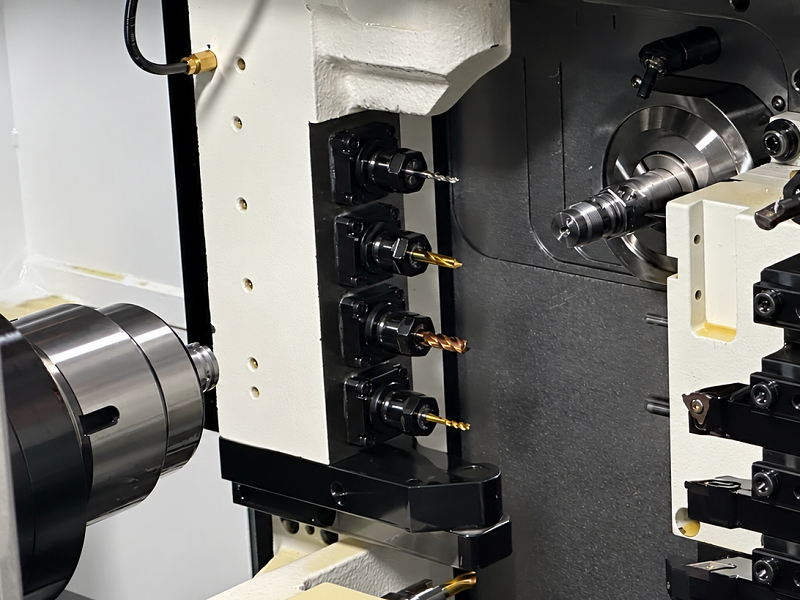
Swiss Turning 101: Main Spindle vs. Sub-Spindle
Swiss Turning 101: Main Spindle vs. Sub-Spindle
When selecting a Swiss-type lathe, customers often focus on spindle speed, tooling capacity and machining accuracy. However, another important consideration is whether the machine is equipped with a sub-spindle. In modern Swiss-type CNC lathes, the main spindle and sub-spindle work together to complete machining operations on both ends of a workpiece. Understanding their different roles can help manufacturers reduce secondary operations and select a more suitable machine configuration.
What Is the Main Spindle?
The main spindle holds and rotates the bar stock during the primary machining process. In a typical Swiss-type lathe, the main spindle is mounted on a sliding headstock, allowing the bar stock to move along the Z-axis while cutting tools perform operations such as turning, drilling, threading, and grooving. When machining with a guide bushing, the material is supported close to the cutting point. This helps reduce material deflection, particularly when machining long and slender components.
Depending on the machine's tooling configuration, the main spindle can also support additional operations such as cross-drilling, milling, and polygon turning.Most of the workpiece's external features are typically completed on the main spindle before the part is transferred to the sub-spindle.
What Is the Sub-Spindle?
The sub-spindle, sometimes called the counter spindle, is positioned opposite the main spindle. Its primary purpose is to receive the workpiece and allow machining operations on the opposite end, commonly referred to as "backworking". During a typical transfer sequence, the sub-spindle approaches the workpiece and grips it before the cut-off operation. Depending on the machine design, the spindles coordinate their positions and rotational speeds to perform the transfer safely. After the workpiece is separated from the bar stock, the sub-spindle holds it for additional machining.
Common backworking operations include:
-
Back-side facing
-
Drilling and boring
-
Internal and external threading
-
Chamfering
-
Milling and other operations, depending on the available tooling
By incorporating these operations into the same machine, manufacturers can reduce the need to transfer partially completed components to another machine for secondary processing.
How Do the Main Spindle and Sub-Spindle Work Together?
A dual-spindle Swiss-type lathe allows machining operations to be divided between the front and back sides of a component.
A typical production sequence follows five stages:
-
Main Spindle Machining: The bar stock is held by the main spindle while the front-side features are machined.
-
Workpiece Transfer: The sub-spindle approaches and grips the workpiece using the appropriate transfer sequence.
-
Cut-Off: The completed front-side portion is separated from the remaining bar stock.
-
Backworking: The sub-spindle holds the separated workpiece while the opposite end is machined.
-
Part Discharge: The finished component is released through the machine's designated discharge system.
On machines equipped with suitable tooling systems and control functions, the main spindle may begin machining the next component while the sub-spindle performs backworking on the previous one. This overlapping process is one of the advantages of a dual-spindle configuration. However, the actual productivity improvement depends on the machining program, tooling arrangement, and the time required for each operation.
When Is a Sub-Spindle Necessary?
The need for a sub-spindle should be determined by the workpiece's machining requirements rather than simply by the number of operations. Consider a small precision component that requires external turning, threading, and a drilled hole on its opposite end. The external turning and threading can be performed on the main spindle. However, the back-side hole may be inaccessible until the component is separated from the bar stock.
Without a sub-spindle, the part may need to be removed, repositioned, and clamped again for a secondary operation. A sub-spindle allows this back-side feature to be machined within the same production cycle, reducing manual handling and additional setups. This is particularly useful for components requiring machining on both ends, especially when consistent positioning and repeatable production are important. However, a sub-spindle is not always necessary. For simple components requiring only front-side machining, a single-spindle configuration may already meet the production requirements.
Does a Sub-Spindle Always Reduce Cycle Time?
Not necessarily. Although a sub-spindle allows additional machining operations and may enable overlapping production, the overall cycle time still depends on how the machining processes are arranged.
For example, consider a component with the following machining requirements:
-
Main spindle machining: 40 seconds
-
Sub-spindle backworking: 5 seconds
If the machine can perform both operations simultaneously on successive components, the main-spindle process remains the primary limitation. In this simplified example, overlapping the 5-second backworking operation with the 40-second main-spindle operation does not reduce the repeating machining cycle below 40 seconds. Actual cycle time will also depend on transfer, cut-off, tool movements, and other machine operations.
The main benefit of the sub-spindle in this case may not be a dramatic reduction in machining time, but rather the elimination of a separate setup and the additional handling required to finish the opposite end. For components with more balanced front-side and back-side machining times, overlapping operations may provide a greater productivity advantage. Therefore, evaluating the machining sequence is just as important as comparing spindle specifications.
Choosing the Right Spindle Configuration
Before selecting a Swiss-type CNC lathe, manufacturers should review the workpiece drawing and identify the operations required on each side of the component.
Several factors should be considered:
-
Workpiece diameter, length, and geometry
-
Front-side and back-side machining requirements
-
Workpiece transfer and clamping conditions
-
Available tooling positions and driven tools
-
Expected production volume
-
Target cycle time
-
Required dimensional accuracy and surface finish
A sub-spindle can provide significant benefits when it eliminates additional setups or allows operations to overlap. However, its actual value depends on the workpiece and production requirements. At SELICA, we help customers evaluate part drawings, material specifications, and machining requirements to determine a suitable Swiss-type CNC lathe configuration. The goal is not simply to increase the number of machining functions, but to achieve an efficient and reliable production process with the right machine configuration.