

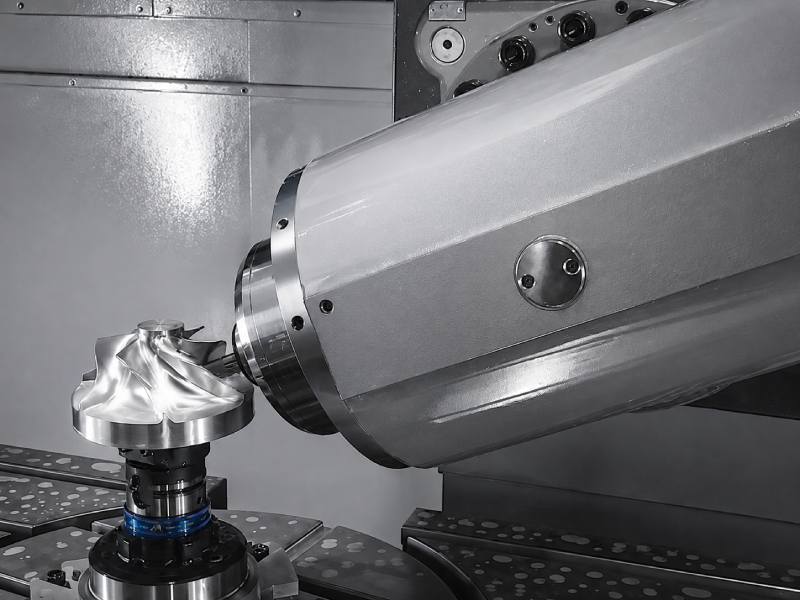
A Simple Guide to 5-Axis Machining
On a 3-axis machining center, the cutting tool moves along the X, Y, and Z axes. This works well for many common parts, but when a workpiece has features on multiple sides, the operator may need to stop the machine, reposition the part, and set it up again. A 5-axis machine adds two rotary axes, allowing the cutting tool to approach the workpiece from different angles. The result? More sides of a part can be machined in a single setup.
3-Axis, 3+2, and 5-Axis: What's the Difference?
This is where things can get a little confusing. A 3-axis machining center moves along X, Y, and Z. It is simple, reliable, and still the right choice for a large range of machining jobs. A 5-axis machine adds two rotary axes to these three linear axes. Depending on the machine design, the table, spindle head, or both can rotate.
But having five axes does not always mean that all five axes are moving at the same time. In 3+2 machining, the rotary axes position the workpiece at a specific angle and then remain fixed while the X, Y, and Z axes perform the cutting.
In simultaneous 5-axis machining, the linear and rotary axes can move together during cutting. This allows the tool to follow complex surfaces and continuously change its approach angle. Both methods have their place. The right choice depends on the geometry of the part and the machining process.
Why Use a 5-Axis Machine?
The biggest advantage is not simply that the machine has “two more axes.” It is about reducing setups and gaining better access to the workpiece. Imagine a part that needs milling, drilling, and contouring on several different faces. On a conventional machining center, the operator may need to remove and reposition the part several times.
Every new setup takes time. It also introduces another opportunity for positioning error. With 5-axis machining, more operations can be completed while the workpiece remains clamped in the same setup. This can provide several practical benefits:
- • Fewer setups and less manual repositioning
- • Better access to multiple sides of a workpiece
- • Improved consistency between machined features
- • Shorter overall production time for complex parts
- • Greater flexibility for complicated geometries
- • Better tool orientation for certain machining operations
For the right type of workpiece, these advantages can make a significant difference. It’s Not Only for Aerospace Parts When people think about 5-axis machining, turbine blades, impellers, and aerospace components often come to mind. And yes, these are classic applications.
But 5-axis machines are useful for much more than extremely complex free-form surfaces. Molds and dies, automotive components, medical parts, precision mechanical components, and general industrial parts with features on multiple faces can all benefit from 5-axis machining. Sometimes the reason for choosing a 5-axis machine is not because the part is extremely complicated.
It may simply be because you want to machine five sides of a component without setting it up five different times. That can be just as valuable.
Does Every Shop Need 5-Axis Machining?
Not necessarily. If most of your work involves relatively simple parts that can be efficiently completed on a 3-axis VMC, moving to a 5-axis machine may not provide enough benefit to justify the additional investment and programming requirements.
But if your production frequently involves multiple setups, difficult tool access, angled holes, complex contours, or tight relationships between features on different faces, 5-axis machining becomes much more attractive.
What Should You Look for in a 5-Axis Machine?
Choosing a 5-axis machining center is not just about comparing the number of axes. Start with the parts you actually need to produce. Consider the workpiece size and weight, X/Y/Z travel, rotary-axis range, table size, spindle speed and power, tool capacity, controller, accuracy requirements, and the type of 5-axis movement required by your application.
The machine structure is also important. Rigidity, rotary-axis design, spindle configuration, and thermal stability can all affect machining performance. And don't forget the process around the machine. CAM software, tooling, workholding, probing, operator experience, and post-processing are all part of a successful 5-axis machining setup. A capable machine is important, but it is only one part of the complete solution.
SELICA SFM-500: Moving into 5-Axis Machining
For manufacturers looking to move beyond conventional 3-axis machining, the SELICA SFM-500 provides a 5-axis machining platform for complex parts and multi-face machining. It is designed to combine the familiar capabilities of a vertical machining center with additional rotary-axis flexibility, allowing manufacturers to reduce workpiece repositioning and approach more complex machining applications. For shops considering their first 5-axis machine, the goal does not always have to be machining the most complicated part possible. Sometimes the real value is much simpler. Fewer setups. Better access. More possibilities from one machine.
That is ultimately what 5-axis machining is about. If you have a part that currently requires several setups on a conventional machining center, send us the drawing. Our team can help evaluate whether 3-axis, 3+2, or 5-axis machining is the more practical solution for your application.