

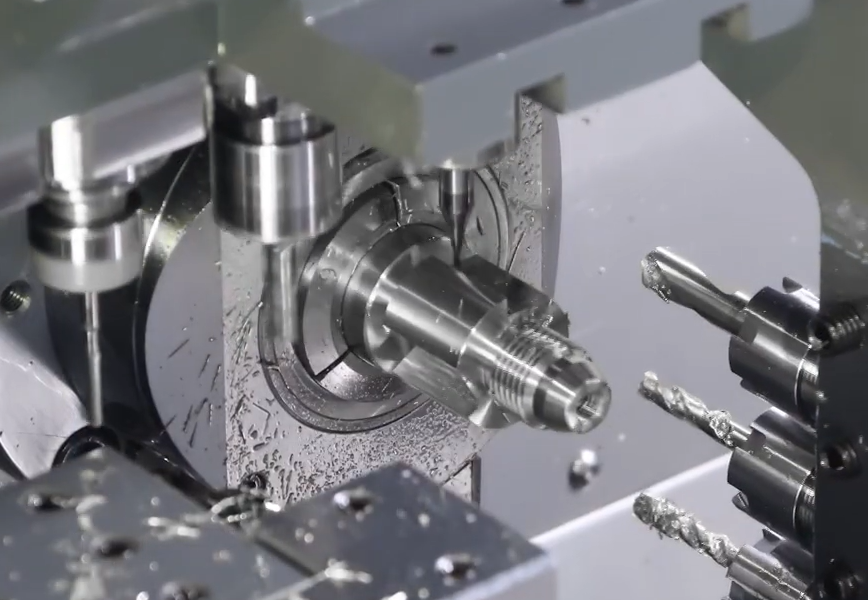
Fixed, Rotary or Non-Guide Bushing: Which Setup Fits Your Part?
When selecting a Swiss-type lathe, the discussion often begins with whether the machine should use a guide bushing. In practice, there are three arrangements to consider: a fixed guide bushing, a synchronous rotary guide bushing and a non-guide-bush setup.
Each arrangement supports the bar stock differently. The right choice depends on the part geometry, material condition and machining process rather than one configuration being better for every application.
Why Is the Guide Bushing Important?
One of the main advantages of a Swiss-type lathe is that the bar stock is supported close to the cutting point. This reduces the unsupported length of the material and helps control deflection during machining.
This support is particularly useful for long, slender parts. However, the bar must pass through the guide bushing with suitable clearance. Its diameter tolerance, straightness and surface condition can therefore affect machining stability and finished-part quality.
Fixed Guide Bushing
With a fixed guide bushing, the bushing remains stationary while the rotating bar stock moves through it. This is a common and practical arrangement for producing long parts with relatively small diameters. Because the cutting takes place close to the guide bushing, the material remains well supported. This can help maintain dimensional consistency when machining slender shafts, pins and other components that might be more difficult to support on a conventional fixed-head lathe.
The condition of the bar stock is important. If the material is bent, inconsistent in diameter or has a rough surface, it may not pass smoothly through the guide bushing. Friction between the rotating bar and the stationary bushing may also affect delicate material surfaces.
Synchronous Rotary Guide Bushing
A synchronous rotary guide bushing rotates together with the main spindle and bar stock. This reduces the relative rotation between the material and the guide bushing.
This arrangement can be useful when machining at higher spindle speeds or when the material surface is sensitive to friction. It may also provide an advantage when surface condition is especially important.
However, a rotary guide bushing is not automatically necessary for every precision part. It adds mechanical components and requires proper synchronisation and maintenance. For many general applications, a fixed guide bushing remains a reliable and economical solution.
Non-Guide-Bush Setup
In non-guide-bush mode, the machine operates without supporting the bar through a guide bushing. The material is held by the main spindle collet, and machining takes place closer to the spindle.
This setup is commonly considered for shorter parts with a lower length-to-diameter ratio. It can simplify material preparation because the bar does not need to match the guide bushing as closely. It may also reduce the remnant length left at the end of the bar, which can be important when machining expensive materials.
The trade-off is reduced support as the cutting position moves farther away from the collet. For long or slender components, this may increase the possibility of vibration or deflection. Non-guide-bush mode is therefore better suited to parts that can remain stable without support near the cutting point.
Which Setup Should You Choose?
The decision should begin with the part, not the machine specification. Important factors include:
- Part diameter and overall length
- Length-to-diameter ratio
- Distance between the cutting point and clamping position
- Bar straightness and diameter tolerance
- Material surface condition
- Required spindle speed
- Surface-finish requirements
- Material cost and expected remnant length
- Production volume
A long, slender part may benefit from the support of a fixed or rotary guide bushing. A shorter component may be produced more economically in non-guide-bush mode. If high spindle speed or material surface condition is a concern, a synchronous rotary guide bushing may be worth considering.
Before recommending a configuration, our team normally reviews the part drawing, material, bar dimensions and expected production quantity. These details allow us to evaluate the required support and determine which setup is more practical for the actual machining process.