

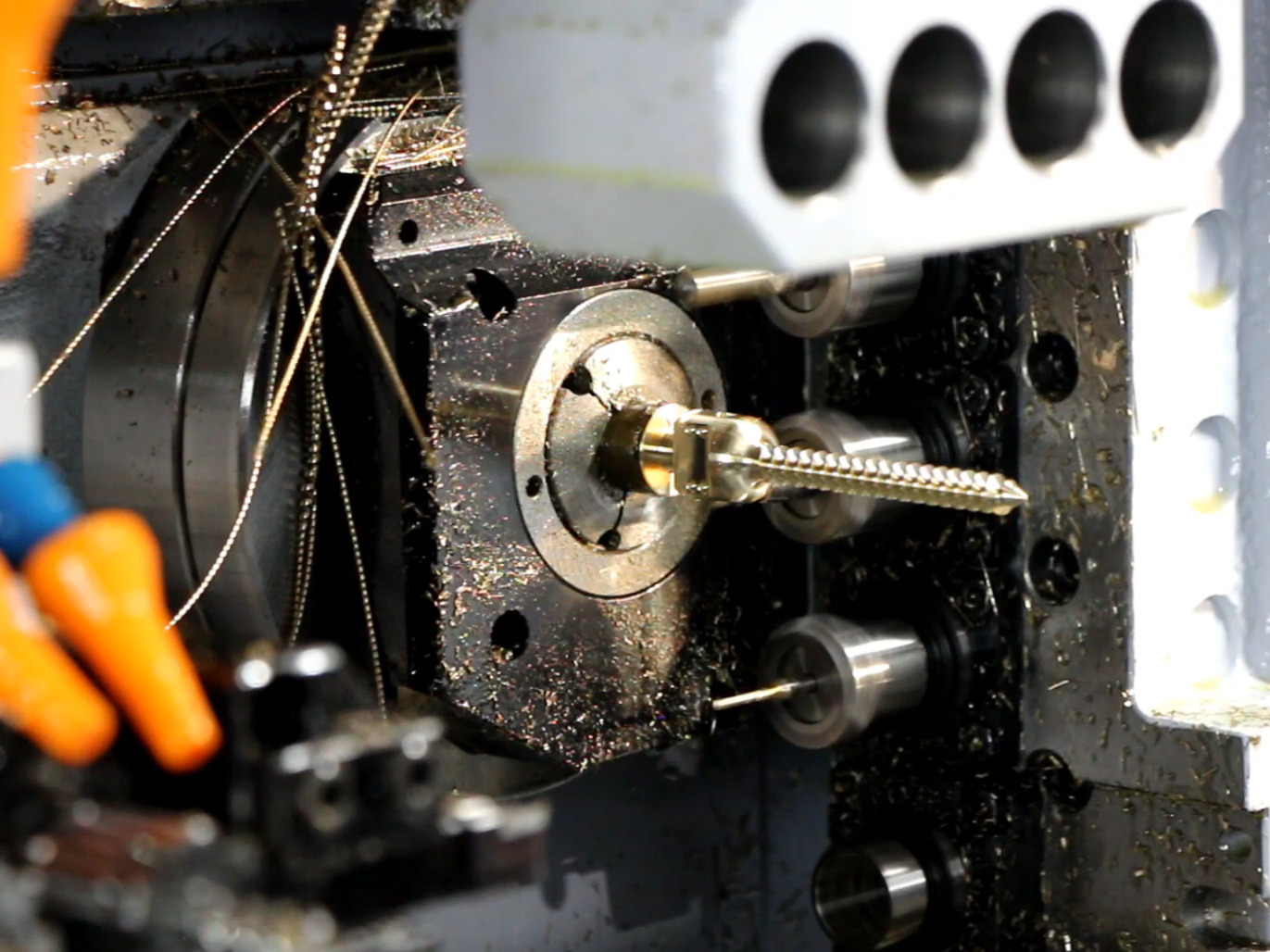
Why Swiss-type CNC Lathes Are Well Suited for Medical Parts
Medical parts are often small enough to fit on a fingertip, but producing them is rarely simple.
A bone screw, dental implant or surgical instrument may include fine threads, deep holes, thin sections and several features that must remain accurately aligned. These components are also commonly machined from titanium alloys or medical-grade stainless steel, materials selected for their strength, corrosion resistance and biocompatibility, but not necessarily for their ease of machining. For manufacturers, the challenge is therefore not only to produce one accurate part. They must maintain the same quality throughout an entire production batch. This is where sliding-head CNC lathes offer a practical advantage.
Why Are Medical Parts Difficult to Machine?
Many medical components are long and slender in relation to their diameter. When conventional turning methods are used, cutting pressure can cause the unsupported section of the material to bend or vibrate. Even a small amount of movement may affect the part’s diameter, concentricity or surface finish. Material behavior is another challenge. Titanium has relatively low thermal conductivity, so cutting heat tends to remain concentrated around the tool and cutting edge. Stainless steel can also generate heat and may work-harden if the cutting conditions are not properly controlled. Stable machining, suitable tooling and effective chip control are therefore essential.
Depending on the application, manufacturers may also need to control:
• Small diameters and thin-wall sections
• Fine external or internal threads
• Tight dimensional tolerances
• Concentricity between multiple features
• Smooth and consistent surface finishes
• Burrs around cross holes or milled features
• Part-to-part consistency during batch production
These requirements make machine stability and process planning especially important.
Support Close to the Cutting Point
The main difference between a sliding-head lathe and a conventional fixed-head lathe is the way the bar stock is supported and moved during machining. On a sliding-head machine, the material passes through a guide bush positioned close to the cutting tool. Instead of leaving a long section of material unsupported, the cutting operation takes place near the guide bush. This support helps reduce deflection and vibration, particularly when machining slender components. It also allows the machine to maintain more stable cutting conditions as the part length increases. For products such as bone screws, pins and dental components, this can provide better control over diameter, straightness and surface finish.
Completing More Operations in One Setup
Medical components often require more than simple turning. A single part may include cross holes, flats, slots, angled features, internal threads or detailed profiles. A multi-axis sliding-head CNC lathe can combine turning, drilling, milling, tapping and other operations within the same machining cycle. Machines equipped with a sub-spindle can transfer the workpiece automatically and complete the rear-side features without requiring the operator to remove and reposition the part. Completing more operations in one setup offers several benefits. It reduces handling time, avoids errors caused by repeated clamping and helps maintain the relationship between features machined on different sides of the component. This is particularly valuable when concentricity and positional accuracy are important.
Typical Medical Applications
Sliding-head CNC lathes are used for a wide range of medical and dental parts, including:
• Bone screws and fixation screws
• Dental implants and abutments
• Surgical pins and guide wires
• Catheter-related components
• Small connectors and instrument parts
• Orthopedic fasteners
• Components used in minimally invasive surgical devices
Each application has different requirements. A dental implant may require detailed thread forms and a consistent external profile, while a surgical pin may place greater emphasis on straightness and surface quality. The advantage of a flexible multi-axis machine is that the cutting process can be arranged according to the actual geometry of the part.
Consistency Matters as Much as Accuracy
Producing an acceptable sample is only the first step. In medical manufacturing, the process must remain stable over repeated production cycles. Bar feeders allow material to be supplied automatically, while tool-life management and in-process inspection can help operators monitor production more effectively. Chip removal and coolant control are also important, especially when working with materials that generate heat or produce difficult chips. A well-planned process should consider the machine, cutting tools, workholding, coolant delivery and inspection method as one complete system. This is usually more effective than focusing on machine specifications alone.
Selecting the Right Machine
Not every medical component requires the same machine configuration. The suitable model depends on several factors, including:
• Maximum bar diameter
• Part length and length-to-diameter ratio
• Number of turning and milling features
• Main- and sub-spindle requirements
• Tool positions and live-tool capability
• Required production volume
• Material and surface-finish requirements
For simpler parts, a compact machine with a straightforward tool layout may be the most efficient choice. More complex components may require additional axes, a sub-spindle or special tooling arrangements. Before recommending a machine, SELICA evaluates the part drawing, raw material, tolerance requirements and expected production volume. This allows us to consider not only whether the part can be machined, but also whether the proposed process is stable and practical for production.
A Practical Solution for Precision Medical Manufacturing
Sliding-head CNC lathes have become an important option for medical manufacturers because they address several common production challenges at the same time: supporting slender material, combining multiple operations and maintaining consistent accuracy during automated production. However, the machine itself is only one part of the solution. The best results come from selecting the correct configuration and developing the machining process around the actual component.
If you are evaluating a bone screw, dental implant, surgical component or another small precision part, send us the drawing and production requirements. The SELICA team can review the application and recommend a suitable machine configuration.