

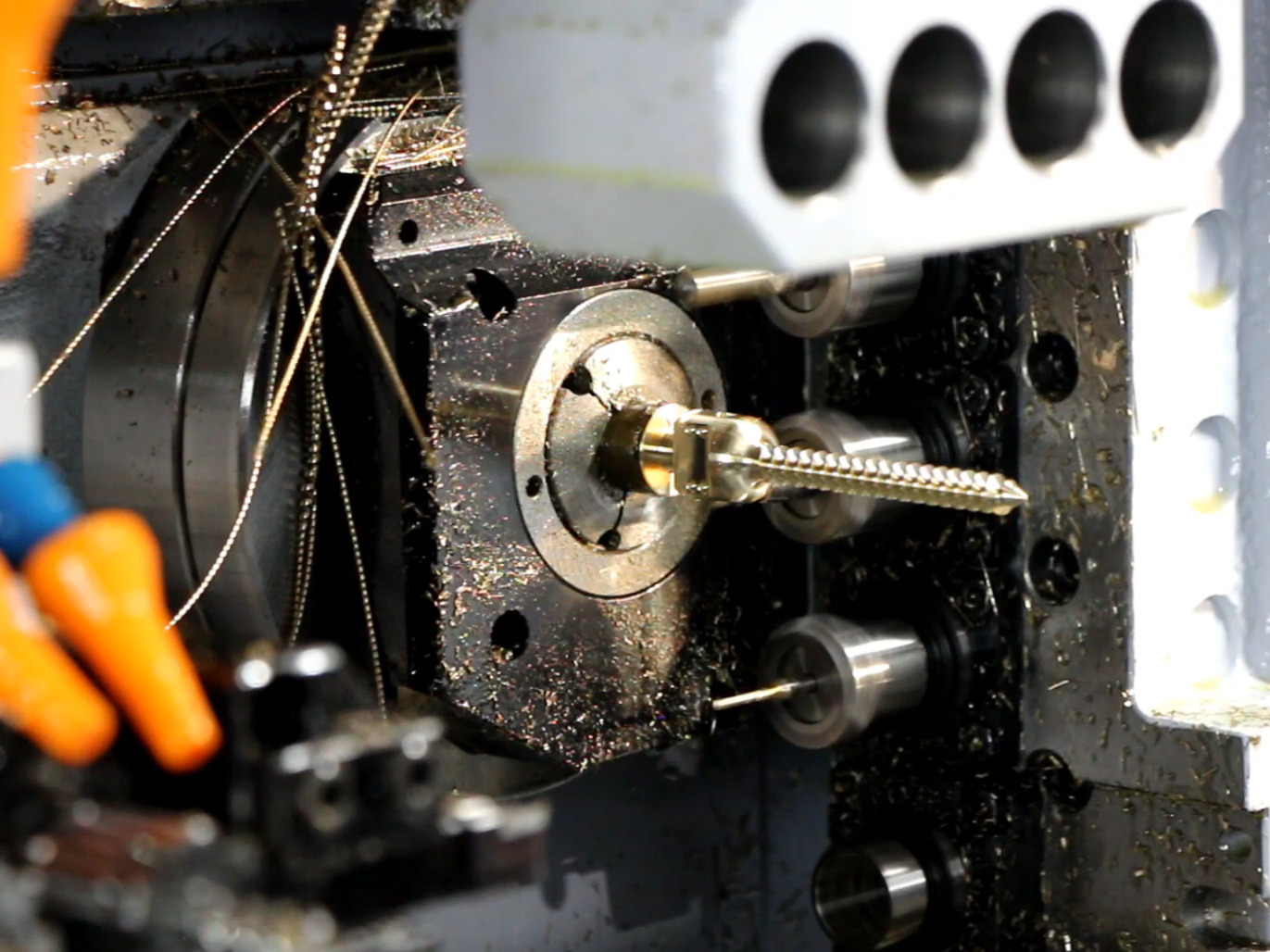
Swiss Turning 101: Why Swiss-Type CNC Lathes Are Ideal for Small Parts
As diameters become smaller, workpieces become more sensitive to cutting force, vibration and deflection. At the same time, many small components require several features to be machined within a very limited space. This is where Swiss-type CNC lathes have a clear advantage.
Support Close to the Cutting Point
One of the key strengths of a Swiss-type lathe is that the bar is supported very close to the cutting area. With a guide bushing, only a short section of material is exposed to cutting force. This helps reduce bending and vibration, especially on small or slender components. For parts with a high length-to-diameter ratio, this can make a significant difference in dimensional stability and surface finish.
Small Diameters Benefit from High Spindle Speeds
Small workpieces generally require higher spindle speeds to achieve the correct cutting speed. Swiss-type machines are designed around small bar diameters and are well suited for high-speed turning and drilling. This makes them a practical choice for parts such as:
- Precision pins
- Shafts
- Screws
- Connectors
- Dental components
- Electronic parts
- Small automotive components
More Features in One Setup
Small parts are often more complex than they appear. A single component may require turning, drilling, cross-drilling, milling, threading and rear-side machining. With live tools, Y-axis capability and a sub-spindle, a Swiss-type lathe can complete many of these operations in one cycle. Reducing the number of setups helps maintain the relationship between different features and also lowers handling time.
Well Suited for Bar-Fed Production
Swiss-type lathes are commonly paired with automatic bar feeders. This allows the machine to process parts continuously from bar stock, making the system especially effective for repeated production. For hundreds or thousands of small parts, automatic feeding can reduce operator involvement and improve overall production efficiency.
The Sub-Spindle Completes the Back Side
For many small components, rear-side machining is required after cut-off. A sub-spindle can receive the part directly from the main spindle and complete these features without moving the component to another machine. This is particularly useful for small parts, where manual handling and reclamping can be difficult.
When Does a Swiss-Type Lathe Make Sense?
A Swiss-type CNC lathe is particularly suitable when the part includes several of the following characteristics:
- Small bar diameter
- Long or slender geometry
- Tight tolerances
- Multiple turning and milling features
- High production volume
- Front- and rear-side machining
- Automatic bar feeding
However, not every small part needs a Swiss-type machine. Very short and simple components may still be more economical on a conventional CNC lathe. The best machine depends on the complete machining process, not the diameter alone.
Built for Small-Part Production
Swiss-type CNC lathes are effective for small parts because their basic design is built around supporting, feeding and machining small bar stock efficiently. The combination of close workpiece support, high spindle speed, multi-axis machining and automated bar feeding makes them particularly suitable for small, precise and repeatable components.