

What Is a Swiss-Type Lathe?
Swiss-type lathes were originally developed to produce small, precise components for the Swiss watch industry. Today, the same machine concept is used for medical components, electronic connectors, automotive parts and other products made from bar stock. The name describes a machine structure rather than a level of accuracy. A Swiss-type lathe can provide excellent results when it is used for a suitable part, but it is not automatically the best choice for every small component. Understanding how the machine supports and moves the material is the first step in deciding whether it fits an application.
How a Swiss-Type Lathe Works
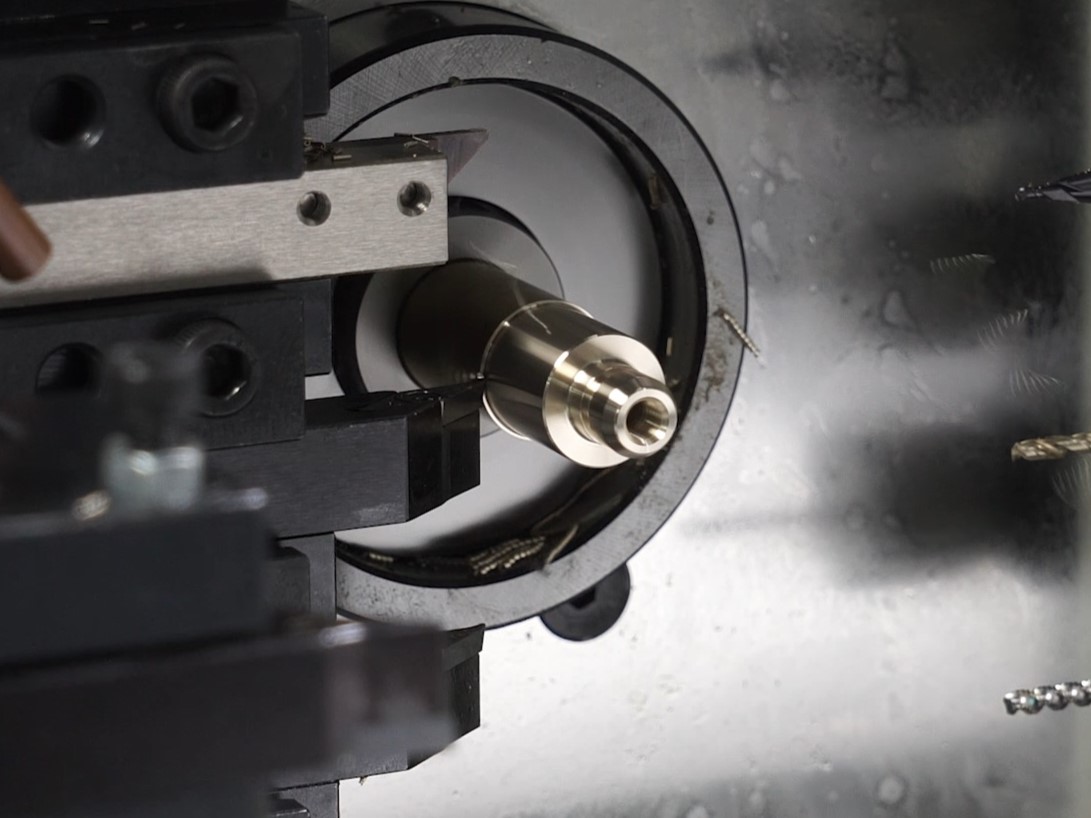
A Swiss-type lathe is also known as a sliding-head type lathe or sliding-headstock lathe. During machining, the spindle rotates the bar and the sliding headstock moves it along the Z-axis. The material passes through a guide bush positioned close to the cutting tools. The tools move along their programmed axes to perform turning, drilling, milling and other operations. The guide bush is the main feature that separates this design from a fixed-head CNC lathe. It supports the bar close to the cutting point, leaving only a short section of material exposed to the cutting force. This support helps reduce bending and vibration when machining a long or slender component. It also allows the machine to maintain more stable cutting conditions as the part extends away from the spindle.
The bar stock usually needs a consistent diameter and suitable straightness because it passes through the guide bush. Material condition and guide-bush adjustment can affect the machining result, so they should be considered as part of the setup.
Machining More Features in One Cycle
Modern Swiss-type CNC lathes are not limited to simple turning. Depending on the configuration, the machine may include a sub-spindle, live tools, Y-axis movement, B-axis tooling and several tool positions. These functions allow turning, drilling, cross drilling, milling, tapping and rear-side machining to be arranged within the same production cycle. A sub-spindle can receive the part from the main spindle and complete the features on the cut-off side. This reduces the need to move the component to another machine for a second operation.
The actual benefit depends on the drawing. A component with only basic turning features may not require a complex machine. A part with cross holes, flats, off-centre features or rear-side machining may justify additional axes and tooling. The machine configuration should therefore follow the required operations rather than the assumption that more axes will always improve production.
Swiss-Type Lathe vs. Fixed-Head CNC Lathe
The main difference between the two machine types is the position of the spindle and the way the workpiece is supported. In a fixed-head lathe, the spindle remains in a fixed position while holding and rotating the workpiece. The cutting tools move along the machine axes. This structure is widely used for short shafts, bushings, flanges and many general turning applications. In a Swiss-type lathe, the headstock moves the rotating bar through the guide bush. This arrangement provides additional support for parts with a high length-to-diameter ratio.
A Swiss-type lathe is often a good option when the component is long and slender, produced from bar stock and includes several turning and milling features. A fixed-head lathe may be more practical for shorter parts, larger diameters, castings, forgings or applications that require heavier cutting. Accuracy and cycle time should not be compared based on machine type alone. The result also depends on the part geometry, material, tooling, setup and machine configuration.
A fixed-head lathe can produce highly accurate components. A Swiss-type lathe can also be inefficient if it is selected for a part that does not benefit from guide-bush support or multi-operation machining.
What Parts Are Suitable for Swiss-Type Machining?
Swiss-type lathes are commonly considered for components that have one or more of the following characteristics:
• A long length relative to the outside diameter
• Small diameters and slender sections
• Several turning, drilling or milling features
• Critical concentricity between front and rear features
• A need to reduce secondary operations
• Repeated production from bar stock
Typical applications include medical screws and pins, dental components, electronic contacts, precision shafts, small connectors, automotive components and aerospace parts.
These examples do not mean that every part in these industries requires a Swiss-type lathe. A short dental component and a long bone screw may have similar diameters but require different machine configurations. The drawing still needs to be reviewed feature by feature.
When a Swiss-Type Lathe May Not Be Necessary
A Swiss-type machine may offer limited benefit when the workpiece is short, rigid and simple to produce on a fixed-head lathe. It may also be unsuitable when the raw material cannot pass through a guide bush, such as some castings, forgings and preformed blanks. Larger components or parts requiring heavy material removal may be better matched to a fixed-head machine with a more suitable spindle and workholding arrangement.
Production quantity is another consideration. Swiss-type lathes are well suited to automatic bar production, but machine capability should still match the expected volume. For a small batch of simple parts, a less complex machine may provide a more economical process. The condition of the bar stock must also be checked. Variations in diameter, poor straightness or an unsuitable surface can affect guide-bush adjustment and machining stability.
Selecting the Machine Configuration
Maximum machining diameter is only the starting point when selecting a Swiss-type lathe.
The following information should be reviewed before confirming a machine:
• Part drawing or 3D model
• Workpiece material
• Bar diameter and condition
• Overall part length
• Critical tolerances and surface finish
• Turning, drilling and milling features
• Required rear-side operations
• Expected production volume and cycle time
These details help determine whether the application requires a sub-spindle, live tools, Y-axis, B-axis, thread whirling or another special arrangement. They also affect the selection of the bar feeder, collets, guide bushes and tool holders. In some cases, a simpler Swiss-type model is sufficient. In others, a fixed-head lathe may be the more practical option. The final decision should be based on the complete machining process.